High-resolution mapping of enzyme activity in tissues
It is now possible to obtain three-dimensional,
high-resolution images of enzyme activity in tissue samples or whole
organs—thanks to probe molecules that anchor fluorescent dyes within
tissue as they are activated by enzymes. The organ being mapped is made
transparent by a clearing process. As a Japanese team reported in the
journal Angewandte Chemie, this allowed for visualization of
differences in aminopeptidase N activity and the effects of inhibitors
in mouse kidneys.
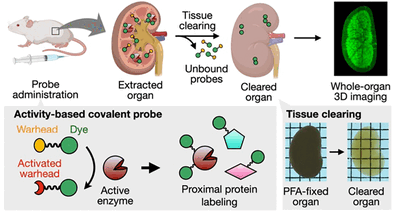
© Wiley-VCH, re-use with credit to 'Angewandte Chemie' and a link to the original article.
Enzymes play a crucial role in regulating physiological
functions and abnormal enzyme activity is related to a variety of
pathological conditions. Enzyme activity varies from organ to organ, as
well as within different regions of a single organ. It would thus be
informative to obtain precise imaging of enzyme activity in tissues with
detailed spatial resolution. Unfortunately, suitable techniques are
lacking. Imaging of enzyme activity is mainly carried out with
fluorescence probes. However, fluorescent light barely penetrates
tissues, so larger samples like whole organs cannot be mapped in 3D. A
process known as clearing could help with this. Clearing is a
traditional process by which tissue samples are made highly transparent
with different solvents and reagents—while maintaining their structure.
However, during the intensive washing, small molecules like fluorescent
probes also get washed out of the tissue.
A team led by Shinsuke Sando at the University of Tokyo has
now developed a new method for imaging the activity of an enzyme in
high-resolution 3D within whole, cleared organs. As an example they
chose aminopeptidase N (APN), a peptide splitting enzyme that plays an
important role in various physiological processes as well as the
development of tumors. Their success was due to a specially developed
probe molecule that consists of a fluorescent dye (BODIPY), an
“anchoring unit”, and an amino acid group (alanine).
If no active APN is present, the probe remains unchanged
and is rinsed out during the tissue clearing process. In regions of the
organ with active APN, the enzyme splits the amino acid group off the
probe, activating the anchoring unit. This attaches to proteins in the
immediate area and solidly anchors the fluorescent probe to the
surrounding tissue structure so that it is not washed away. This allowed
the team to obtain high-resolution, 3D maps of APN activity with
fluorescence microscopy in whole mouse kidneys. The researchers were
even able to visualize differences in APN activity in individual tubular
structures within the kidneys.
The team also studied the effects of APN inhibitors. They
observed different patterns in the suppression of fluorescence between
the experimental antitumor agent actinonin and another APN inhibitor.
These differences may result from differences in absorption, metabolism,
and/or pharmacokinetics. The new imaging technology opens the way to an
unbiased evaluation method for drug development that does not overlook
tiny phenomena that occur on the cellular level in whole organs.
(3113 characters)
About the Author
Dr. Shinsuke Sando is a Professor of Chemistry and
Biotechnology at the University of Tokyo and has been active in the
field of chemical biology for over 20 years. His research focuses on the
design and development of functional molecules for applications in
chemical biology and bioimaging.
Copy free of charge—we would appreciate a transcript/link of your
article. The original articles that our press releases are based on can
be found in our online pressroom.