Redox mediator improves performance and lifespan of Li-O2 batteries
Lithium–air batteries have the potential
to outstrip conventional lithium-ion batteries by storing significantly
more energy at the same weight. However, their high-performance values
have thus far remained theoretical, and their lifespan remains too
short. A Chinese team has now proposed addition of a soluble catalyst to
the electrolyte. It acts as a redox mediator that facilitates charge
transport and counteracts passivation of the electrodes.
© Wiley-VCH, re-use with credit to 'Angewandte Chemie' and a link to the original article.
In contrast to lithium-ion batteries, in which lithium ions
are “pushed” back and forth between two electrodes, lithium-air
batteries (Li-O2) use an anode made of metallic lithium. As the battery is used,
positively charged lithium ions dissolve and move over to the porous
cathode, which has air flowing through it. Oxygen is oxidized and bound
into lithium peroxide (Li2O2). Upon charging, the
oxygen is released, and the lithium ions are reduced back to metallic
lithium, which deposits back onto the anode. Unfortunately, the
theoretically high performance of such batteries has not become a
reality.
In practice, an effect known as overpotential slows the
electrochemical reactions: the formation and decomposition of insoluble
Li2O2 are slow and its conductivity is also very
low. In addition, the pores of the cathode tend to become clogged, and
the high potential required for the formation of oxygen decomposes the
electrolyte and promotes undesirable side reactions. This causes the
batteries to lose the majority of their performance after only a few
charge/discharge cycles.
A team led by Zhong-Shuai Wu from the Dalian Institute
of Chemical Physics of CAS, collaborating with Xiangkun
Ma from the Dalian Maritime University, has now proposed the addition of a
novel imidazole iodide salt (1,3-dimethylimidazolium iodide, DMII) to
act as a catalyst and redox mediator to enhance the performance and
lifespan.
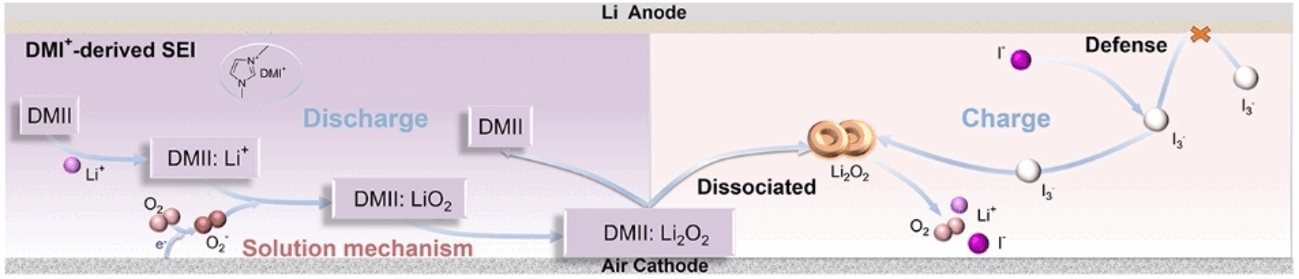
The iodide ions (I−) in the salt can
easily react to form I3− and then back again
(redox pair). In this process, they transfer electrons to oxygen
(discharge) and take them back up (charge). This facilitated charge
transport accelerates the reactions, reduces the overpotential of the
cathode, and increases the discharge capacity of the electrochemical
cell. The DMI+ ions from the salt contain a ring made from
three carbon and two nitrogen atoms. This ring has freely mobile
electrons and can “capture” lithium ions during discharge and
effectively transfer them to the oxygen at the cathode. In addition, the
DMI+ ions form an ultrathin but highly stable interface film
on the anode, which prevents direct contact between the electrolyte and
the lithium surface, minimizing the decomposition of the electrolyte and
preventing side reactions. This stabilizes the anode and increases the
lifespan of the battery.
The electrochemical test cells produced by the team were
highly promising, demonstrating a very low overpotential (0.52 V), high
cycle stability over 960 hours, and highly reversible
formation/decomposition of Li2O2 with no side
reactions.
(3145 characters)
About the Author
Dr Zhong-Shuai WuZhong-Shuai Wu is a Chair Professor and group leader of
2D Materials Chemistry & Energy Applications at the Dalian Institute of
Chemical Physics, CAS. His research interests revolve around topics of
the chemistry of graphene and 2D materials, surface and
nanoelectrochemistry, microscale electrochemical energy storage devices,
supercapacitors, batteries, and energy catalysis.
Copy free
of charge—we would appreciate a transcript/link of your article. The
original articles that our press releases are based on can be found in
our online pressroom.