Light-controlled antigen release for analysis of antigen processing
Our immune system is always on alert, detecting and
eliminating pathogens and cancer cells. Cellular control mechanisms
cause diseased cells to present antigens on their surface like signs
for the immune system. For analysis of the necessary complex antigen
processing and transport processes in real time, a German team has
developed a “cage” that is opened with light to release trapped
antigens at a specific place and time, as reported in the journal Angewandte
Chemie.
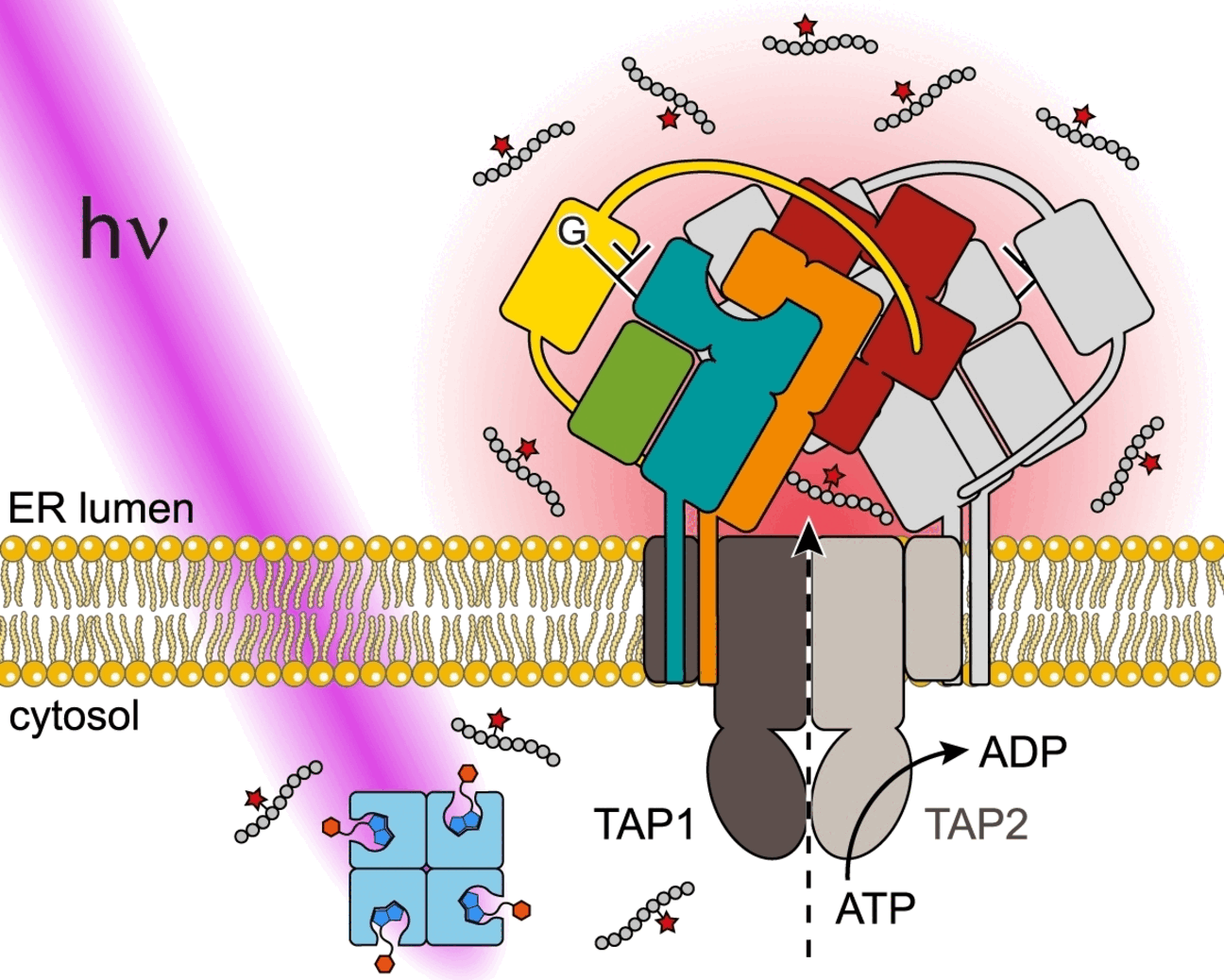
© Wiley-VCH, re-use with credit to 'Angewandte Chemie' and a link to the original article.
In our cells, both endogenous and foreign proteins are
constantly broken into tiny pieces and transported into the endoplasmic
reticulum (ER), a branched system of channels enclosed by a membrane, by
the transporter associated with antigen processing (TAP). There, the
supramolecular peptide loading complex PLC controls the loading of MHC I
(major histocompatibility complex class I) with antigenic peptides.
Certain peptides are preferentially loaded onto MHC I, further processed
for immune surveillance (antigen processing) and presented on the cell
surface. Peptides that come from normal endogenous proteins remain
immunologically inconspicuous (barring misdirected autoimmune reactions).
Despite many new insights, the mechanistic principles of
antigen translocation, dynamic PLC assembly, and the interaction between
different PLC subunits in the “quality control” of peptide-MHC complexes
remain generally unknown. To further analyze antigen processing, Ralph
Wieneke, Robert Tampé, and their team at the University of Frankfurt am
Main (Germany) have now developed a photostimulated antigen release
system that can be used to precisely study antigen flux. The antigens
are released (antigen burst) on command from a “caged” inactive state by
the application of light. The advantage of light stimulation is that it
can be precisely dosed at limited times and locations and is
noninvasive, which allows for experiments in living cells.
The team used a peptide derived from an HIV antigen as
their model. They used a linker to bind the epitope (section of an
antigen) to biotin and then the biotin to a voluminous protein called
streptavidin. In this state, the epitope is shielded to the extent that
it can no longer be recognized by the antigen processing transporter
(TAP). The linker contains a group that can be split apart by light.
When irradiated with UV light, the peptide epitope is immediately
released from its “cage”. It is then recognized by TAP and transported
across the ER membrane and loaded onto MHC I by way of the PLC.
This method is versatile, as demonstrated by a variety of
scenarios, such as tracing antigen transport by the TAP of native human
PLC in the ER membrane of a human lymphoma cell line. According to
Wieneke and Tampé, “it is our aim to use the light-activated system to
follow the antigen processing pathway through different cellular
compartments and gain an understanding of the kinetics of various
immunological processes in vivo.”
(3054 characters)
About the Author
Robert Tampé is renowned for his research in
membrane biology, cellular quality control, antigen processing and
recognition. He serves as the director of the Institute of Biochemistry
at Goethe-Universität Frankfurt (Germany). Dr. Ralph
Wieneke is a senior scientist and group leader at the Institute of
Biochemistry at the same university. His main specialty is
chemical biology with a focus on membrane associated processes and
optochemical immunology.
Copy free of charge—we would appreciate a transcript/link of your
article. The original articles that our press releases are based on can
be found in our online pressroom.