Oxidation triggers debonding of mussel-inspired adhesive
Modern integrated microelectronic devices are often poorly
repairable and difficult to recycle. Debondable adhesives play a key
role in the transition to a circular economy with sustainable resources,
less waste, and intelligent repair/recycling strategies. In the journal Angewandte
Chemie, a research team has now introduced a method for making
adhesives that can be deactivated “on command”.
© Wiley-VCH, re-use with credit to 'Angewandte Chemie' and a link to the original article.
Their inspiration came from the masters of underwater
adhesion: mussels. Mussel-inspired adhesives have been developed before.
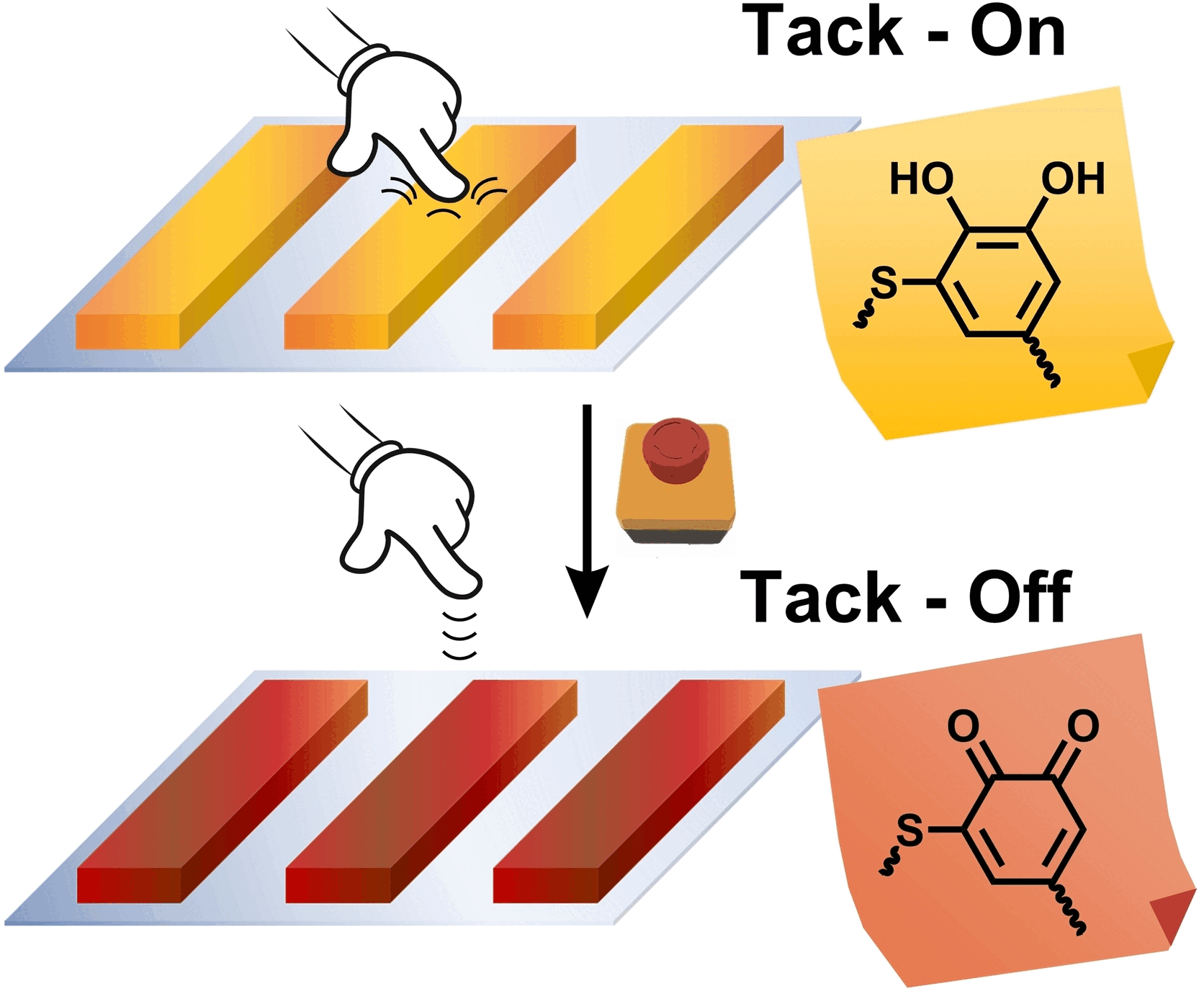
These new versions are based on thiol-catechol polyaddition, which forms
polymers with adhesive thiol-catechol connectivities (TCC,
thiol-substituted six-membered aromatic rings with two neighboring OH
groups which are responsible for the strong adhesive properties). The
trick is that when the catechol groups in the adhesive polymers are
oxidized to quinones (six-membered rings with two oxygen atoms bound by
double bonds), the strength of adhesion decreases dramatically.
Changing the basic framework of the monomers allows for
control over the properties of the polymers. Kannan Balasubramanian,
Hans Börner, and their team at Humboldt University zu Berlin, the
Leibniz Institute for Analytical Sciences (ISAS, Berlin,
Germany), Universidad Nacional de General San Martin (Buenos Aires,
Argentina), the Fraunhofer Institute for Applied Polymer Research
(Potsdam-Golm, Germany), and the company Henkel (Düsseldorf, Germany)
have now produced two different types of TCC adhesives with strong
adhesion and shear strength.
Biobased, peptidic biscatechol precursors of DiDOPA, which
is similarly found in mussels, were compared with their fossil-based
analog. Both adhesives also function under water and are insensitive to
atmospheric oxygen and weak oxidizing agents. However, they lose their
stickiness through oxidation with the strongly oxidizing sodium
periodate (NaIO4), so that the adhesive residues can be easily peeled or
wiped off the substrate in one piece.
While the oxidation of the fossil adhesive inactivates the
catechols, but at the same time makes the adhesive more
hydrophobic, the
biobased type shows the deactivation without becoming dramatically
more
hydrophobic due to a variety of other peptide functionalities.
Börner
explains: "The multifunctionality is typical of biomaterials, in
which
often only the key functionalities are switched off and not much
else
changes in the material. This circumstance enables a dramatically
more
efficient de-adhesion mechanism, which reduces the adhesive
strength of
the bio-based type by 99%." The reason for the poorer deactivation
(60%) of the fossil-based adhesive lies in the compensation, as
hydrophobic
polymers are also very good adhesives.
In the longer term, the consortium is working on replacing
chemical oxidation with direct electrochemical oxidation, which could be
interesting for the repair of cell phones, for example.
(3003 characters)
About the Author
Prof. Dr. Hans G. Börner leads the Laboratory of
Organic Synthesis of Functional Systems at the Humboldt-Universität zu
Berlin (Germany). The current research interests of his group are
devoted to bioinspired polymer science concepts, where selected peptides
and resulting peptide–polymer conjugates are exploited to enable
specific interactions for materials science applications.
Copy free of charge—we would appreciate a transcript/link of your
article. The original articles that our press releases are based on can
be found in our online pressroom.