Fluorescence probe and autofluorescence quencher in one
Quick assessment of trace blood components in untreated blood samples
is possible with fluorescence tests but, in practice, blood’s strong
autofluorescence interferes with the analysis. In the journal Angewandte Chemie,
a research team has now introduced a novel fluorescence probe that
quenches this autofluorescence and precisely quantifies traces of
hydrogen sulfide, which is an important signal molecule.
© Wiley-VCH, re-use with credit to 'Angewandte Chemie' and a link to the original article.
Some blood components are present in extremely low concentrations but
are anything but unimportant. For example, the toxic gas hydrogen
sulfide H2S, which smells of rotten eggs, is an important
messenger molecule in the body. It is, among other things, involved in
regulating circulation. Patients with cardiovascular diseases usually
have a reduced H2S concentration in their blood, whereas
patients with colon cancer often have elevated levels. The
quantification of this and other trace components are correspondingly
helpful in forming a diagnosis, and for the investigation of
physiological and pathological relationships.
Fluorescence tests are especially powerful in the analysis of
biomolecules. They are inexpensive, uncomplicated, highly sensitive, and
can be used for real-time measurements. The problem is that trace
components cannot be detected in whole blood samples because blood
itself strongly fluoresces, overwhelming weaker signals. Whole blood is
therefore centrifuged and only the plasma is analyzed. However, this
reduces the concentrations of unstable components and gas molecules,
yielding inaccurate results.
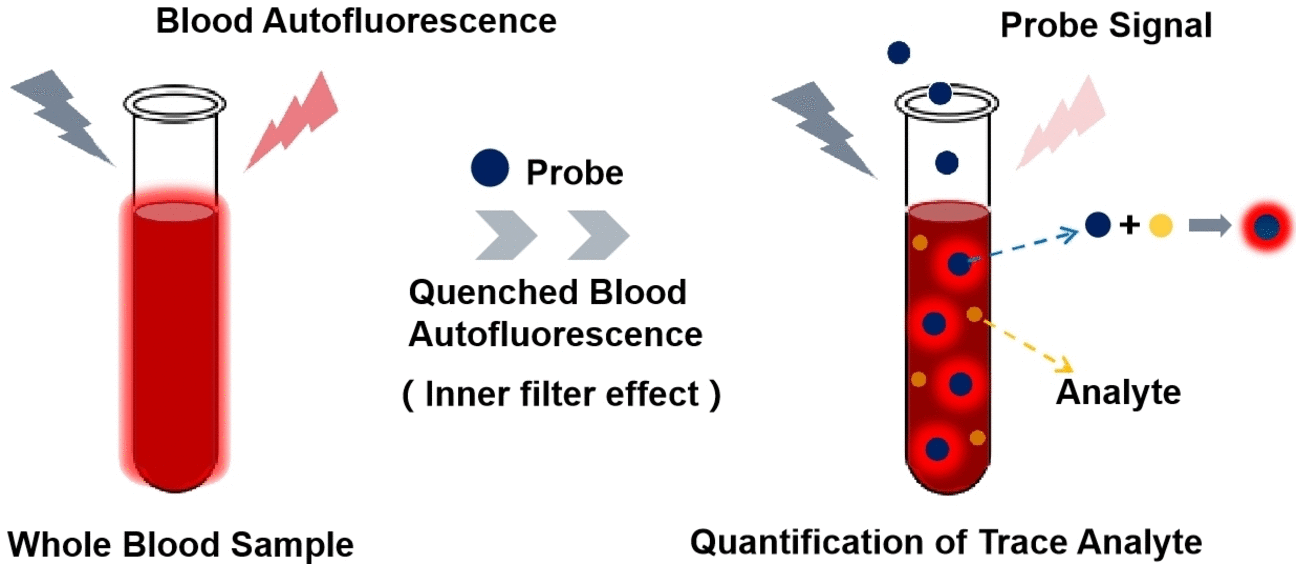
A team led by Hongwen Liu and Ronghua Yang at Hunan Normal University
(Changsha, China) has now developed a novel technique for fluorescence
tests that can successfully quantify H2S in whole blood. The
trick is that the fluorescence probe itself almost completely quenches
the interfering autofluorescence of the blood. The fluorescence dye very
strongly absorbs the light that is given off by the autofluorescence of
blood components. The fluorescence dye used is based on
borodipyrromethene (BODIPY) that has been modified by the addition of
two molecular fragments that “recognize” H2S. The presence of H2S
activates the probe and it begins to fluoresce. Because the
autofluorescence of the blood remains quenched, the background
fluorescence remains very low and does not interfere.
Fluorescence tests using the new probe on whole blood samples from
patients with cardiovascular diseases verified their reduced H2S levels. Tests on mice with colon cancer showed, also as expected, elevated blood H2S
concentrations. In addition, red blood cells from mice were treated
with allicin. Allicin is the fragrant compound in garlic that is also
responsible for its positive medicinal effects, such as reducing blood
pressure. The team was able to use their new probe to demonstrate that
allicin triggers the formation of H2S in red blood cells.
The researchers hope to use this strategy to develop additional probes for other trace analytes in whole blood.
(3073 characters)
About the Author
Dr. Hongwen Liu is
an Associate Professor at the College of Chemistry, Hunan Normal
University. His current research interests include constructing novel
small molecules for biosensing, bioimaging, and cancer treatments.
Copy
free of charge—we would appreciate a transcript/link of your article.
The original articles that our press releases are based on can be found
in our online pressroom.