The development of highly secure but simple and inexpensive
encryption technology for the prevention of data leaks and forgeries is
decidedly challenging. In the journal Angewandte Chemie, a
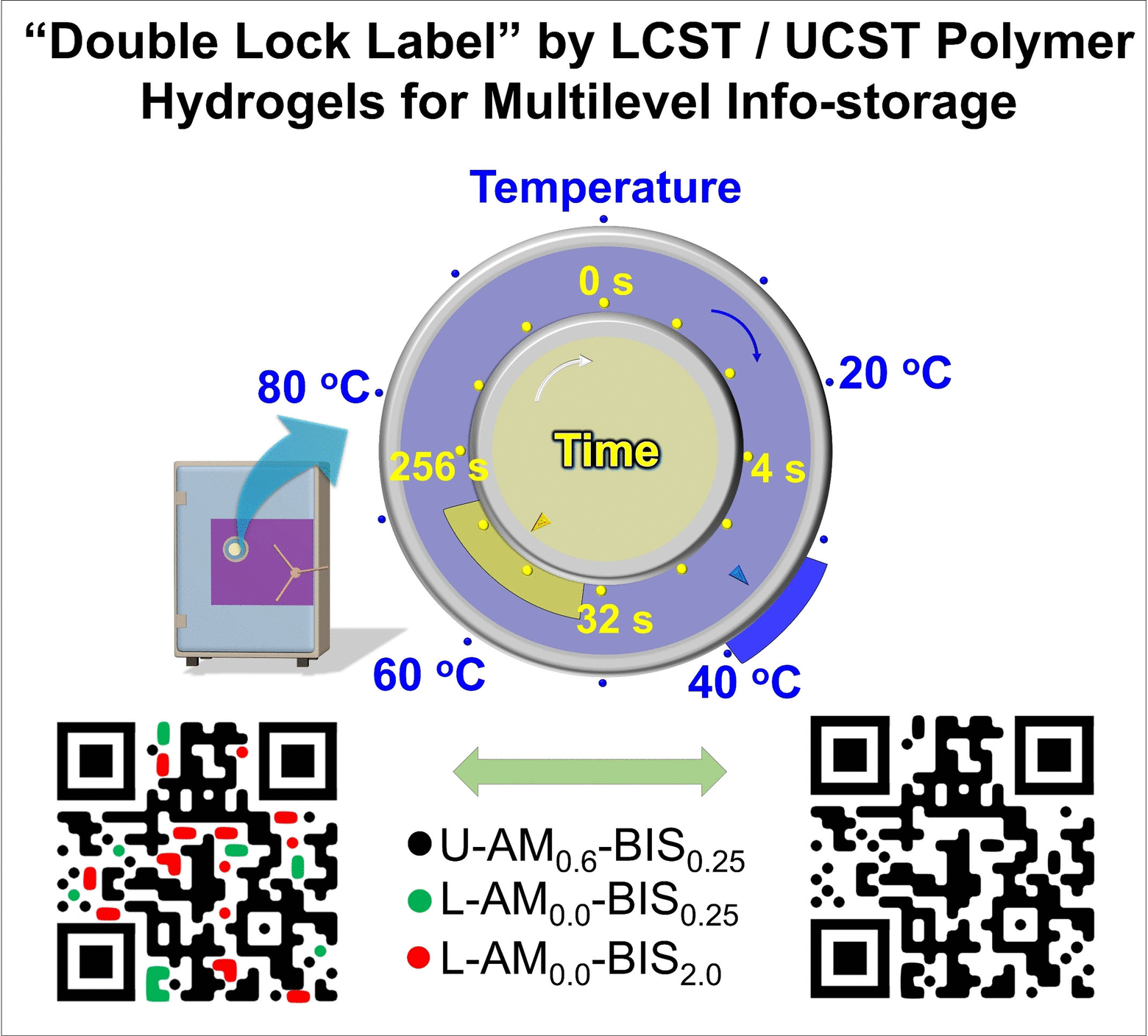
research team has introduced a “double lock” based on thermoresponsive
polymer hydrogels that encrypts information so that it can only be read
at a specific window in temperature and time.
© Wiley-VCH, re-use with credit to 'Angewandte Chemie' and a link to the original article at https://doi.org/10.1002/anie.202117066
In addition to digital encryption methods, physical methods play an
important role. Their decoding is typically based on external stimuli
such as light or heat. Multiple stimuli offer more security, but make
reading the data cumbersome and complex. “Addition of the time domain
greatly raises the chance to achieve the unity of security and
simpleness,” according to the team led by Zhikun Zheng, Xudong Chen, and
Wei Liu, at Sun Yat-sen University (Guangzhou, China). “We were
inspired by the baking of bread: delicious bread can only be produced if
the baking temperature is not too low or too high and the baking time
is not too short or too long.”
For their novel “double encryption system” they use thermoresponsive
polymer hydrogels—cross-linked chain molecules with water incorporated
into their “gaps”. Above or below a specific temperature, the clear gels
become opaque due to partial unmixing. There are LCST and UCST gels,
which have lower or upper critical solution temperatures, respectively.
The phase retention and critical temperature can be controlled via the
content of –CO–NH2 groups in the main chain of the polymer hydrogels. The density of cross-linking determines the rate of the phase transition.
As an example of a locked label, the team used transparent acrylic
plates with grooves in the pattern of a QR code. Three different gels
were put in defined areas of the pattern; a UCST gel with a phase change
around 40 °C, and two LCST gels with a phase change at 33 °C (one with a
fast phase transition, and one with a slow phase change). Below 20 °C,
the UCST gel is opaque, but highly shrinking. The pattern is deformed
and unreadable. Between 20 and 33 °C, it swells and the part of the code
formed by this gel becomes readable. The second part of the code,
formed by the “fast” LCST gel, still cannot be read. Only heating to
over 33 °C makes both LCST gels opaque. Now the timing comes into play;
only the pattern of the “fast” LCST gel has the correct second part of
the information. At 37 °C, it becomes readable after about half a minute
and the complete code can be read. However, a brief three minutes
later, the “slow” LCST gel becomes opaque and adds false information
that makes the codes unreadable. Above 40 °C, both LCST gels become
opaque simultaneously. In addition, the UCST gel becomes transparent and
unreadable.
This encryption can only be decoded if the specific temperature and
time windows are known. The source of heat for decoding in this example
could be an infrared lamp, a water bath, a hair dryer, or even the human
body. If sealed to prevent the evaporation of water, these inexpensive
labels are theoretically suitable for long-term use.
(3131 characters)
About the Author
The Optical
Encryption Research Team, led by Prof. Xudong Chen at Sun Yat-sen
University, Guangzhou, China, focus their research on optical
manipulation of materials for applications in information storage,
encryption and anticounterfeiting by utilizing optical principles
combined with multilevel structure control of polymer (optical)
materials and device design.