A synthetic sulfide mineral with thermoelectric properties
To convert heat into electricity, easily accessible materials from
harmless raw materials open up new perspectives in the development of
safe and inexpensive so-called thermoelectric materials. A synthetic
copper mineral acquires a complex structure and microstructure through
simple changes in its composition, thereby laying the foundation for the
desired properties, according to a study published in the journal Angewandte Chemie.
© Wiley-VCH, re-use with credit to 'Angewandte Chemie' and a link to the original article.
The novel synthetic material is composed of copper, manganese,
germanium, and sulfur, and it is produced in a rather simple process,
explains materials scientist Emmanuel Guilmeau, CNRS researcher at
CRISMAT laboratory, Caen, France, who is the corresponding author of the
study. “The powders are simply mechanically alloyed by ball-milling to
form a precrystallized phase, which is then densified by 600 degrees
Celsius. This process can be easily scaled up,” he says.
Thermoelectric materials convert heat to electricity. This is
especially useful in industrial processes where waste heat is reused as
valuable electric power. The converse approach is the cooling of
electronic parts, for example, in smartphones or cars. Materials used in
this kind of applications have to be not only efficient, but also
inexpensive and, above all, safe for health.
However, thermoelectric devices used to date make use of expensive
and toxic elements such as lead and tellurium, which offer the best
conversion efficiency. To find safer alternatives, Emmanuel Guilmeau and
his team have turned to derivatives of natural copper-based sulfide
minerals. These mineral derivatives are mainly composed of nontoxic and
abundant elements, and some of them have thermoelectric properties.
Now, the team has succeeded in producing a series of thermoelectric
materials showing two crystal structures within the same material. “We
were very surprised at the result. Usually, slightly changing the
composition has little effect on the structure in this class of
materials,” says Emmanuel Guilmeau describing their discovery.
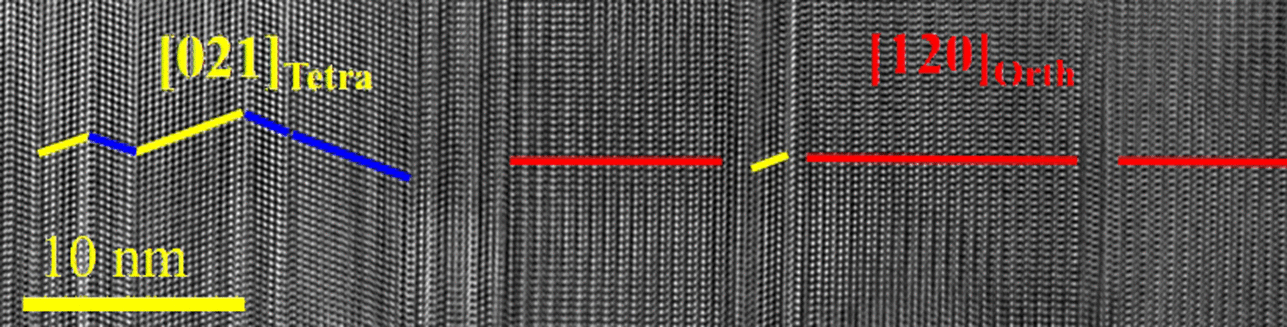
The team found that replacing a small fraction of the manganese with
copper produced complex microstructures with interconnected nanodomains,
defects, and coherent interfaces, which affected the material’s
transport properties for electrons and heat.
Emmanuel Guilmeau says that the novel material produced is stable up
to 400 degrees Celsius, a range well within the waste heat temperature
range of most industries. He is convinced that, based on this discovery,
novel cheaper and nontoxic thermoelectric materials could be designed
to replace more problematic materials.
(2700 characters)
About the Author
Emmanuel Guilmeau is
a CNRS Director of Research at the Laboratoire de Cristallographie et
Sciences des Matériaux (CRISMAT), located at the University of Caen
Normandie/ENSICAEN, France. His research interests are in the area of
synthesis, materials chemistry and physics, and compositional design of
thermoelectric materials, with different processing and characterisation
methods.
Copy free of charge—we would appreciate a transcript of
your article. The original articles that our press releases are based on
can be found in our online pressroom.